Texas Courts Are at it Again: Federal Court Enjoins CTA and BOI Rule

On December 3, 2024, Judge Mazzant of the U.S. District Court for the Eastern District of Texas issued a nationwide preliminary injunction against enforcement of the Corporate Transparency Act of 2024 (“CTA”), including a stay of its Beneficial Ownership Information Reporting Rule (“BOI Rule”). The BOI Rule requires legal entities formed or registered to do business in the U.S. to report ownership information to the U.S. Department of the Treasury’s Financial Crimes Enforcement Network (“FinCEN”) on or before January 1, 2025. Because of the injunction, the CTA and BOI Rule are paused pending the outcome of the lawsuit, and businesses need not comply with reporting requirements at this time. However, the Department of Justice has appealed the decision to the 5th Circuit Court of Appeals, where the government will presumably request that the decision be reversed or applied only to the parties in that particular case.


While the fate of the CTA and BOI Rule hangs in the balance, business owners in New York are not off the hook just yet. New York is slated to implement its own beneficial ownership reporting requirement, the so-called “New York LLC Transparency law,” beginning on January 1, 2026. This new law, which takes the form of an amendment to New York’s current LLC and Executive laws, requires limited liability companies (only) to identify each beneficial owner and each applicant of the LLC, unless an exemption applies.


All beneficial ownership disclosures and attestations of exemption will be filed electronically with the New York Department of State. Penalties for failure to file by the due date include fines and possible suspension, dissolution, or cancellation of an LLC.o your intake process.


Questions or comments? Please contact us at (646) 213-9044 or info@andrieuxlaw.com.

Scales and gavel portrait
March 26, 2026
The decision in Flowers Title Companies, LLC v. Bessent (E.D. Tex. Mar. 19, 2026) has had an immediate and significant impact on FinCEN’s Anti-Money Laundering (AML) Residential Real Estate Reporting Rule, effectively halting its implementation nationwide. At least for now. Rule Vacated in Its Entirety The court vacated (set aside) the rule in full, meaning the AML reporting requirements for covered real estate transactions are no longer legally in force. This includes obligations on title companies, attorneys, and settlement agents. The court held that FinCEN exceeded its authority under the Bank Secrecy Act, making the rule invalid. Immediate Suspension of Reporting Obligations Following the ruling, FinCEN confirmed that there is currently no requirement to file real estate reports and there will be no liability for failing to report while the decision remains in effect. In practical terms, the compliance regime that began on March 1, 2026 is now paused. Nationwide Impact (Not Just Texas) The court’s order vacated the rule nationwide, not just for the parties involved. This means all “reporting persons” across the U.S. are currently relieved from compliance obligations. The regulatory framework has reverted to the pre-rule environment (i.e., no comprehensive nationwide reporting requirement for these transactions). Legal Reasoning: Limits on FinCEN Authority The court’s reasoning has broader implications. Specifically, the Bank Secrecy Act does not authorize blanket reporting of all non-financed real estate transactions, and as such, FinCEN cannot impose obligations on non-financial institutions in the manner attempted. Moreover, the rule improperly treated all covered transactions as inherently suspicious. This reasoning could constrain future AML rulemaking beyond real estate. Ongoing Uncertainty (Appeals Likely) Despite the immediate impact, the situation remains fluid. The government is expected to appeal and a court could stay (pause) the ruling, which would reinstate the rule temporarily. Other courts have already issued conflicting decisions, increasing the likelihood of appellate resolution. Practical Implications Short-term: Reporting is not currently required and compliance deadlines are effectively on hold. Medium-term: Firms should continue collecting data where feasible in case the rule is reinstated and compliance programs should remain flexible and ready to react. Long-term: The case may reshape how far FinCEN can extend AML obligations into non-bank sectors, including real estate. The March 19, 2026 Flowers ruling effectively shuts down FinCEN’s Real Estate AML Reporting Rule for now, removing immediate compliance obligations. However, because the decision is likely to be appealed and could be reversed or stayed, the rule is best viewed as paused but not permanently dead. Questions or comments? Please contact us at (646) 213-9044 or info@andrieuxlaw.com .

Benefits of forming a business entity.
March 13, 2026
Starting a business is an exciting step, but one of the most important early decisions an entrepreneur makes is whether to formally establish a business entity. While some individuals begin as sole proprietors by default, forming a legal structure such as a corporation or limited liability company (LLC) can provide significant financial, legal, and operational advantages. Choosing the right entity lays a foundation for long-term stability and growth. Limited Liability Protection One of the primary benefits of forming a business entity is personal liability protection. When operating as a sole proprietor, there is no legal distinction between the owner and the business. This means personal assets such as a home, savings, or vehicles may be at risk if the business faces lawsuits or debt. By contrast, forming an entity creates a separate legal identity. Business structures such as corporations or LLCs generally shield owners from personal responsibility for business obligations, provided legal formalities are maintained. This separation significantly reduces personal financial exposure and encourages responsible risk-taking. Tax Advantages and Flexibility Forming a business entity may offer meaningful tax benefits. Different structures are taxed in different ways, allowing owners to select an arrangement aligned with their financial goals. For example, an LLC typically benefits from pass-through taxation, meaning profits and losses are reported on the owners’ personal tax returns, avoiding double taxation. Alternatively, some businesses elect S corporation status to potentially reduce self-employment taxes. Larger enterprises may choose a C corporation to retain earnings for expansion, though this structure involves taxation at both the corporate level and the personal level. This flexibility to choose how a business is taxed can lead to significant savings and strategic advantages over time. Enhanced Credibility and Professional Image Forming a business entity can improve credibility with customers, vendors, and financial institutions. Operating under a registered business name and formal structure signals professionalism and long-term commitment. Clients and partners often feel more confident entering contracts with a legally recognized company rather than an individual. Additionally, banks and investors are more likely to provide funding to established entities, especially corporations or LLCs with proper documentation and governance structures. Easier Access to Capital Raising capital is often easier when a business is formally structured. Corporations, in particular, can issue shares of stock to attract investors. While LLCs cannot issue stock in the same way, they can admit new members and allocate ownership interests. A structured entity also allows for clearer financial reporting, ownership percentages, and profit distribution agreements—elements that investors and lenders require before committing funds. Continuity and Transferability Another major advantage is continuity. Sole proprietorships typically dissolve upon the owner’s death or departure. In contrast, corporations and LLCs can continue operating regardless of changes in ownership. Ownership interests can be transferred or sold, making succession planning and exit strategies more manageable. This continuity enhances business stability and long-term planning. Structured Management and Growth Formal entities provide a framework for governance and decision-making. Corporations, for instance, establish roles such as directors and officers, creating clear lines of authority. LLCs can define management structures in operating agreements, reducing ambiguity and potential disputes. As a company grows, this structure becomes increasingly valuable. It clarifies responsibilities, protects stakeholder interests, and supports scalable operations. Conclusion Forming a business entity is more than a bureaucratic step; it is a strategic decision that influences liability protection, tax treatment, credibility, funding opportunities, and long-term sustainability. While each structure has distinct advantages and regulatory requirements, establishing a formal entity provides entrepreneurs with a stronger legal and financial foundation. Careful planning and professional guidance can ensure that the chosen structure aligns with your business’s goals and growth trajectory. Questions or comments? Please contact us at (646) 213-9044 or info@andrieuxlaw.com .

March 1, 2026
The U.S. Department of the Treasury’s Financial Crimes Enforcement Network (FinCEN) has officially implemented its long-anticipated Residential Real Estate Reporting Rule, marking a significant expansion of anti-money laundering (AML) requirements in the real estate sector. Effective March 1, 2026, the rule introduces a nationwide reporting regime targeting certain high-risk real estate transactions—particularly those historically used to obscure beneficial ownership and facilitate illicit financial activity. Key Highlights 1. Scope of Covered Transactions. The rule applies to non-financed (all-cash or privately financed) transfers of U.S. residential real estate where the buyer is a legal entity or trust. Includes LLCs, corporations, partnerships, and trusts. Covers residential properties such as 1-4 family homes, condos, co-ops, and certain vacant land. No minimum purchase threshold applies. 2. Reporting Obligations. Designated “reporting persons” (e.g., settlement agents, title companies, attorneys) must file a Real Estate Report with FinCEN. Reports must disclose beneficial ownership information. Filing deadline: generally, within 30 days of closing. 3. Focus on Transparency. The rule specifically targets transactions that bypass traditional financial institution oversight—closing a long-standing regulatory gap in AML enforcement. 4. Replacement of Geographic Targeting Orders (GTOs). The rule replaces prior GTOs (which targeted similar all-cash transactions in specific cities, such as New York and Miami) with a permanent, nationwide framework, eliminating geographic limitations and expanding coverage. Recent Developments The rule was delayed from its original December 2025 effective date to allow additional time for industry compliance. Implementation has not been without controversy, including legal challenges and evolving regulatory interpretations, highlighting the complexity of applying AML obligations to real estate transactions. Practical Implications Real estate professionals must update compliance programs, train staff, and identify reporting responsibilities in each transaction. Buyers using entities or trusts should expect increased scrutiny and disclosure requirements. Legal and compliance teams should align this rule with broader obligations, including FinCEN’s Corporate Transparency Act reporting (where applicable). FinCEN’s new rule represents a major shift toward greater transparency in U.S. real estate transactions, particularly those involving opaque ownership structures and cash purchases. Market participants should ensure they understand the scope, reporting triggers, and operational impact to avoid compliance risks. Questions or comments? Please contact us at (646) 213-9044 or info@andrieuxlaw.com .

Empty operatory.
February 16, 2026
Patient abandonment is one of the most serious allegations that can be made against a healthcare professional. It sits at the intersection of ethics, law, and patient safety—and when mishandled, it can result in professional discipline, malpractice claims, and harm to patients. Understanding what constitutes abandonment, how to prevent it, and how to properly terminate a patient relationship is essential for every healthcare practice. What Is Patient Abandonment? Patient abandonment occurs when a healthcare provider unilaterally terminates the provider-patient relationship without reasonable notice or a reasonable opportunity for the patient to secure alternative care, especially when ongoing medical attention is necessary. Accordingly, for a termination of care to constitute abandonment, two elements are typically required: (1) an established provider-patient relationship, and (2) withdrawal from care at a critical stage without adequate notice or transition. However, not every termination of care is abandonment. Providers have the right to end a professional relationship under appropriate circumstances, if done correctly. When Does a Provider–Patient Relationship Exist? A provider–patient relationship is generally formed when: A provider affirmatively agrees to diagnose or treat a patient; A patient reasonably relies on the provider’s professional services; and Care has been initiated (e.g., treatment plans, prescriptions, follow-up appointments). Once established, the provider assumes a duty of care that continues until it is properly terminated. Common Scenarios That Lead to Abandonment Claims Abandonment claims often arise in situations such as: Failure to provide follow-up care after surgery or treatment; Ignoring repeated missed or cancelled appointments without formal discharge procedures; Closing a practice without proper patient notification; Failure to respond to urgent patient calls during active treatment; and Refusal to continue care without notice, particularly in chronic or high-risk cases. Ethical Considerations Ethically, abandonment undermines core principles of healthcare such as acting in the patient’s best interest, avoiding harm, and honoring professional commitments. Even when a patient is non-compliant, disruptive, or unable to pay, providers must follow structured and documented termination procedures. Legal Consequences If abandonment is established, providers may face: Malpractice lawsuits; Licensure board investigations; Professional discipline; Financial damages; and/or Reputational harm Among other factors, courts may examine whether: The patient required ongoing care; The provider gave adequate written notice; The patient was given sufficient time to secure another provider; and The provider offered emergency coverage during the transition. The standard for “reasonable notice” varies by jurisdiction and clinical context but is often 30 days for non-emergent cases. Proper Termination of the Provider-Patient Relationship To minimize risk, healthcare practices should implement clear termination protocols: 1. Provide written notice. Send a formal letter stating: The effective date of termination; The reason (optional but advisable if neutral and factual); and The timeframe during which emergency care will continue. 2. Allow adequate time for transition. Typically, 30 days, though urgent or specialty cases may require more time. 3. Offer referral resources. While not always legally required, offering assistance in locating alternative care demonstrates good faith. 4. Facilitate the transfer of patient records. Provide instructions on how records can be released promptly upon request. 5. Document everything. Maintain detailed records of: Patient behavior (if relevant); Missed/cancelled appointments; Communication attempts; and Copies of termination notices. Special Considerations in Group Practices When a provider leaves a group practice, questions arise about who “owns” the patient relationship. Courts often consider: Who billed for services; How the patient perceives the relationship; and The terms of any contractual agreements. In any event, clear employment contracts and patient communication are critical during transitions. Risk Management Strategies Healthcare organizations can reduce patient abandonment risk by: Developing written termination policies; Training staff on communication standards; Implementing consistent documentation practices; Ensuring coverage during vacations or provider departures; Consulting legal counsel before terminating complex cases. Conclusion Patient abandonment is not merely a legal technicality—it is a patient safety issue with serious ethical and professional implications. While providers are not obligated to treat every patient indefinitely, they must disengage from care responsibly. Clear policies, careful documentation, and thoughtful communication are the cornerstones of preventing abandonment claims. When handled properly, termination of care can protect both patients and providers, preserving trust, safety, and professional integrity. Questions or comments? Please contact us at (646) 213-9044 or info@andrieuxlaw.com .

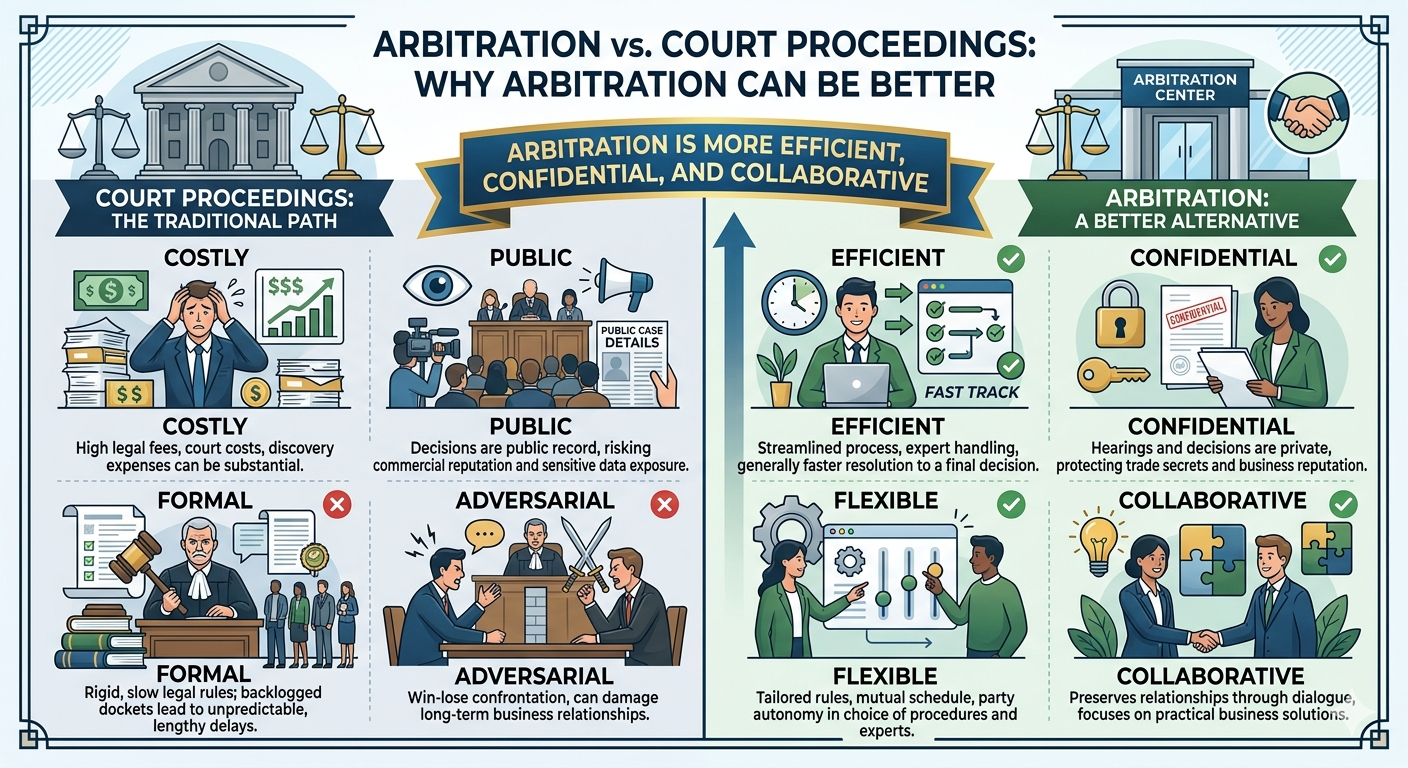
Arbitration vs. court.
January 17, 2026
In modern commerce, disputes are sometimes unavoidable. Even well-drafted contracts cannot prevent every disagreement about performance, payment, or interpretation. When conflicts arise, businesses must choose how those disputes will be resolved. Increasingly, companies are opting for arbitration rather than traditional courtroom litigation, and for good reason. Arbitration offers a faster, more efficient, and more specialized path to resolving business conflicts while preserving valuable commercial relationships. One of the most significant advantages of arbitration is speed. Court litigation can take years to resolve due to congested dockets, procedural delays, and multiple layers of appeals. Arbitration, by contrast, is designed to move quickly. Parties typically set their own timelines with the arbitrator, hearings can be scheduled sooner than court trials, and the procedural framework is streamlined. For businesses that need certainty and closure to move forward, this efficiency is invaluable. Cost is another critical factor. Litigation often involves extensive discovery, numerous motions, and prolonged court proceedings, all of which drive up legal fees and operational disruption. Arbitration generally limits discovery and procedural formalities, which can substantially reduce costs. While arbitrators’ fees must be paid by the parties, the overall expense of arbitration is often lower because disputes are resolved more quickly and with fewer procedural hurdles. Arbitration also provides expertise that courts may lack. In litigation, judges and juries may not have specialized knowledge of the industry involved in the dispute. Arbitration allows parties to select an arbitrator with relevant experience, whether in healthcare, finance, construction, technology, or another complex sector. This expertise can lead to more informed decisions and a better understanding of the commercial context of the dispute. Confidentiality is another important advantage. Court proceedings are typically public, meaning sensitive business information may become part of the public record. Arbitration proceedings, however, are generally private. This privacy helps protect trade secrets, proprietary information, and reputational interests, which is an especially important consideration for companies operating in competitive markets. Additionally, arbitration offers greater flexibility and control. Parties can tailor procedures to fit the needs of the dispute, including selecting the governing rules, the location of the arbitration, and the qualifications of the arbitrator. This level of customization allows businesses to design a dispute-resolution process that aligns with their operational priorities. Finally, arbitration can help preserve business relationships. Litigation is often adversarial and public, which can permanently damage commercial partnerships. Arbitration’s private and less formal setting may encourage cooperation and facilitate settlements, allowing parties to resolve disputes without completely destroying the possibility of future collaboration. Of course, arbitration is not perfect. Limited appeal rights mean that an unfavorable decision is usually final, and in some cases the cost savings may not be as significant as anticipated. Nevertheless, for many business contracts, the benefits of arbitration—speed, efficiency, expertise, confidentiality, and flexibility—make it an attractive alternative to litigation. Questions or comments? Please contact us at (646) 213-9044 or info@andrieuxlaw.com .

Modern white dental office reception area with curved desk, wood floors, and blue accent.
August 1, 2025
Question
Warning sign.
June 4, 2025
Under the New York Worker Adjustment and Retraining Notification (WARN) Act, if you employ 50 or more individuals, 90 days’ written notice is required if at least 25 employees will experience certain types of employment losses, including more than a 50% reduction in hours per month for a 6-month period or a furlough/layoff lasting more than 6 months. Notice must also be given to the affected employees and/or their representatives, the New York Department of Labor, and the Local Workforce Investment Board. Failing to comply with the WARN Act can result in liability for back wages and lost benefits, as well as civil penalties. The WARN Act does not apply if the reduction in hours or furlough/layoff is carried out as part of a Shared Work Program through the NY Department of Labor, in which the employees receive unemployment benefits to partially compensate for their reduced wages. However, the WARN Act will apply if the wage reductions or furloughs/layoffs persist after the Shared Work Program ends. There is also a limited exception to the 90-day notice requirement for unforeseeable business circumstances. An unforeseeable circumstance must not have been reasonably foreseeable when the 90-day notice would have been required (for example, if the clinic’s major funding source collapses suddenly and without warning). Even in these situations, employers are still required to provide as much notice as practicable. For our out-of-state readers, the Federal WARN Act which applies to employers with 100 or more employees and requires 60 days’ written notice. Questions or comments? Please contact us at  (646) 213-9044  or  info@andrieuxlaw.com  .

US currency (bills and coins) on top of an American flag.
May 15, 2025
Client Question 
Hand placing coin on stack with glowing house icon and rising arrows, suggesting financial growth in real estate.
April 7, 2025
CLOSING COSTS PAID BY THE BUYER In addition to the purchase price of the property, buyers should be prepared to pay certain out-of-pocket expenses at or prior to the closing. The most typical of these include: Attorneys’ fees: Charged by your real estate attorney to prepare and review the contract of sale and perform title clearance activities. Courier fee: Paid to the title closer for the transportation of paper documents. Property inspection: Even if an inspection isn’t required, it’s wise to get one to help uncover any issues with the property before you buy it. Property insurance: Protects against physical damage to your property and personal belongings due to fire, wind, and other perils; and other risks that occur after you purchase the property, such as theft or injury to a third party. Property taxes: If the seller has paid property taxes for a period beyond the closing date, you can expect to reimburse the seller your pro rata share of such payment. Recording fee: Charged by the county for recording public land records, such as deeds and mortgages. Survey fee: Charged by a surveying company to confirm a property’s boundaries. Title insurance: Protects against financial losses arising from issues with the property’s title, such as liens (e.g., unpaid taxes, mortgages), encroachments (e.g., a neighbor’s fence on your property), title defects (e.g., errors in public records). title fraud, and other ownership disputes that existed before you bought the property. Title searches: The buyer is responsible for hiring a title company to search property records to ensure there aren’t any known issues with the property’s title, such as judgment or tax liens. CLOSING COSTS PAID BY THE SELLER Although buyers bear the bulk of closing costs, sellers don’t get off scot-free. As a seller, you’ll typically pay your own attorneys’ fees; your pro rata share of property taxes if, as of the closing date, you haven’t paid the taxes for the current period; and a transfer tax imposed by the state to transfer title to the buyer. Questions or comments? Please contact us at  (646) 213-9044  or  info@andrieuxlaw.com  .

HHS logo.
March 27, 2025
During a HIPAA audit, the Office for Civil Rights (OCR) examines an organization’s compliance with the Health Insurance Portability and Accountability Act of 1996 (HIPAA), focusing on policies, procedures, and practices related to protecting patient information, including administrative, physical, and technical safeguards. The following is an overview of what the OCR looks for in a HIPAA audit: Policies and Procedures. Review of written policies related to HIPAA, including Privacy, Security, and Breach Notification Rules. Administrative Safeguards. Assessment of data access management, employee training on HIPAA, and security policy implementation. Physical Safeguards. Evaluation of physical security for protecting both electronic and paper health information. Technical Safeguards. Review of technologies used to protect electronic health information (ePHI), such as encryption and access controls. Training. Confirmation that staff are properly trained on HIPAA regulations and the organization’s policies. Breach Notification Procedures. Examination of processes for detecting, investigating, and reporting HIPAA breaches. Audit Trails. Checking if audit trails are maintained to monitor access to ePHI. Risk Analysis. Assessment to ensure a thorough risk analysis is done to find and reduce vulnerabilities. Compliance with Specific Requirements. The OCR may focus on specific requirements of the Privacy, Security, or Breach Notification Rules, or may examine a broader scope of requirements. HIPAA violations can result in both civil and criminal penalties, including fines ranging from $141 to over $2 million, and even potential imprisonment for intentional violations. Avoid these excessive consequences of non-compliance: It all starts with your HIPAA policies and procedures, which will guide your practice in tackling the issues listed above to become (and stay) HIPAA compliant. Questions or concerns about your HIPAA compliance practices? Please contact us at  (646) 213-9044  or  info@andrieuxlaw.com  .